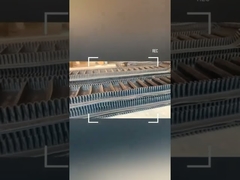
Brief: This video demonstrates the setup, operation, and key moments during typical use of the ST630 ST2000 Scratch Cold Resistant Conveyor Belt. You will see how its specialized cover rubber and fabric core perform reliably in extreme cold environments, learn about its technical classifications for scratch resistance and temperature ratings, and get a clear overview of its available specifications for industrial applications.
Related Product Features:
Features a robust core made from cotton, nylon, or polyester canvas for structural integrity.
Cover rubber combines natural and butadiene rubber for high elasticity and impact resistance.
Designed for reliable operation in extremely cold environments down to -40°C.
Available in scratch-resistant (H), wear-resistant (D), and general (L) cover rubber types.
Offers two cold resistance levels: C1 for -45°C to 50°C and C2 for -60°C to 50°C.
Supports a wide range of core materials including NN100 through NN500.
Accommodates belt widths from 100mm to 3000mm for various industrial setups.
Constructed with 1 to 10 fabric layers and customizable cover rubber thicknesses.
Sıkça Sorulan Sorular:
What is the minimum temperature at which this cold-resistant conveyor belt can operate?
The ST630 ST2000 conveyor belt is designed for normal use in environments as low as -40°C. Its specialized cold-resistant grades, C1 and C2, extend this range to -45°C and -60°C respectively, ensuring performance in extreme cold.
What are the different types of cover rubber available for this belt?
The belt is available in three cover rubber types based on performance: Scratch-resistant (H) for environments with scraping or gouging, Wear-resistant (D) for high-abrasion applications, and General (L) for standard use cases.
What core materials and specifications are offered for this conveyor belt?
The belt uses cotton, nylon, or polyester canvas cores, with specific strength ratings from NN100 to NN500. It comes in widths from 100mm to 3000mm, with 1 to 10 fabric layers, and cover rubber thickness from 1.5mm to 8.0mm on the working surface.